November 7 - 8, 2026, Brisban, QSD Australia:
The Spectral Body
A Phase 5 Ortho-Bionomy Class
What if the body extends beyond what can be seen or touched?
Phase 5 invites us to explore the subtle territory where movement, perception, memory, and relationship meet. Here the body is experienced not simply as anatomy, but as a living field of awareness—responsive, relational, and continually reorganizing itself.
As we approach the body with curiosity rather than correction, long-held patterns of protection often become more flexible—not because we overcome them, but because new possibilities become available. What once served us well may no longer be necessary, allowing greater ease, resilience, and freedom of movement to emerge.
Through touch, observation, and play, we'll investigate how presence changes what becomes possible, and how practitioner and client participate together in an unfolding process of discovery.
This class emphasizes reciprocity, curiosity, and the art of "doing no-thing"—less as techniques to master than as ways of cultivating trust in the body's innate capacity for self-organization and change.
Join us as we explore the spectral body: the living, relational body that is always more than we can see, and perhaps knows more than we can tell.
No prerequisites -- all are welcome
Antigonish
Yesterday, upon the
stair,
I met a man who wasn't there!
He wasn't there again today,
I wish, I wish he'd go away!
When I came home last night at three,
The man was waiting there for me
But when I looked around the hall,
I couldn't see him there at all!
Go away, go away, don't you come back any more!
Go away, go away, and please don't slam the door... (slam!)
Last night I saw upon the stair,
A little man who wasn't there
He wasn't there again today
Oh, how I wish he'd go away....
William Hughes Mearns
"This [Phase 5] is a breakaway from the original concept. Instead of the 'operator' connecting the patient, the patients bring about their own correction by directing the operator's hands, by a mentally patterned proprioceptive neuro-etheric muscular reflex. This may sound complex but in fact it is very simple to teach to anyone with a necessary understanding of energy."
––ARTHUR LINCOLN PAULS
Phases are different perspectives, different ways of looking at the body/person.
When shall we open our minds to the conviction
that the ultimate reality of the world is neither matter nor spirit, is no definite thing, but a perspective?
--José Ortega y Gasset
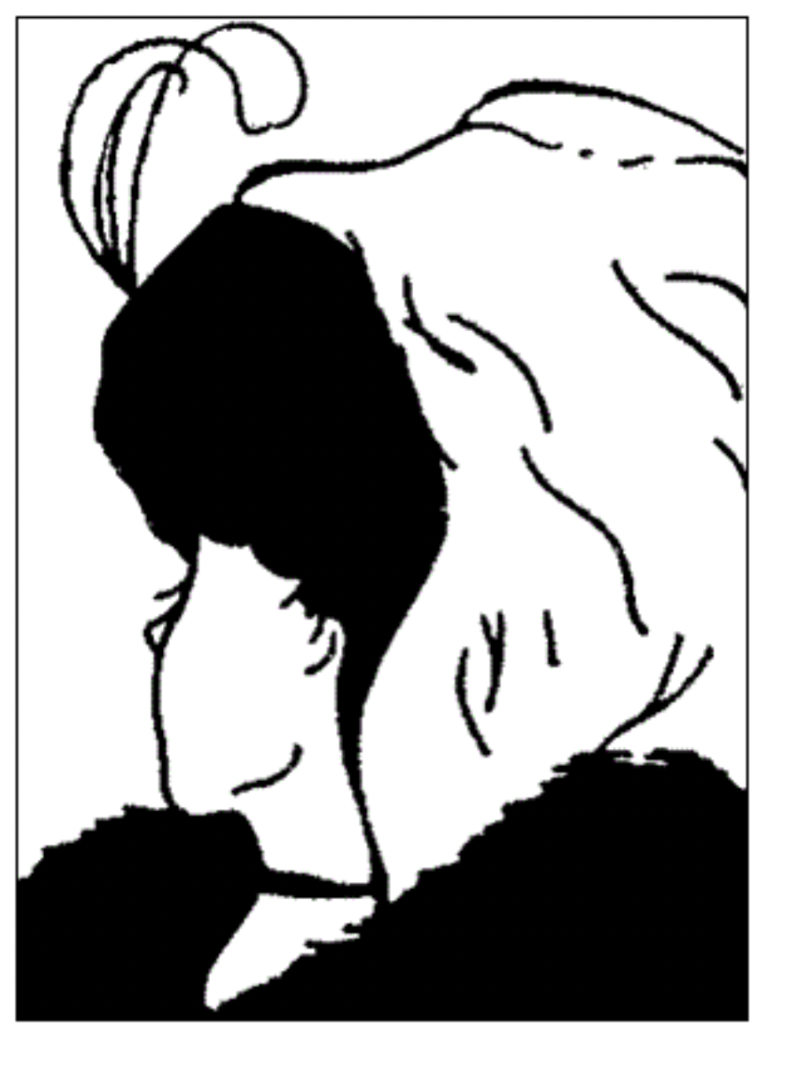 "My wife and my mother-in-law" W.E. Hill. 1915
You can always come up with other ways of looking at things. That's what the Phases gives us, different ways to approach the Body, different portals, different perspectives.
Play -- The As-If Body
Play is Phase 2 of Ortho-Bionomy as described by Arthur Pauls (Philosophy and History of Ortho-Bionomy), and Phase 5 of orthobionomy (that is, my version of Ortho-Bionomy, not necessarily the official version) can be thought of as playing with the As-If body. Doing orthobionomy should be fun and learning should be fun. Serious Fun.
The Body Schema
Body Image is your conscious perception of your body. But underneath your awareness, your brain keeps an operational map of your entire body: its position, its pressure, its boundaries, its threat level; this map is called your Body Schema.
Before the flesh moves intentionally, the movement is emulated in the body schema, the as-if body. We have a biological susceptibility to the as-if.
Spectral refers to things that are there and not there at the same time, much like Walt Whitman's phrase "both in and out of the game." Spectrality describes the body schema very nicely, as well as Arthur Pauls's statement, "The event has already occurred, we are only performing the ritual."
Reciprocity
Most simply defined, reciprocity is a practice of exchanging things with others for mutual benefit. Mutualism is a related term.
While theories of evolution have constrained our thinking to focus on competition and "survival of the fittest, there has been another, possibly more important force at work. In the latter part of the 20th century, some biologists, most notably Lynn Margulis, began shifting the focus to the role of reciprocity and mutualism. Earlier still, the French anthropologist Marcel Mauss published in 1925 The Gift: Forms and Functions of Exchange in Archaic Societies. Mauss brought to the fore the role of reciprocity in human relations. This essay continues to resonate deeply.
Reciprocity is a foundational principle of orthobionomy, to the extent that care of the self and care of the other are the same action. The individual body does not exist separate from the social body.
Who is leading, who is following? Meeting in the metaphysical middle.
Luck –– Chance –– Randomness
Phase 3 of Ortho-Bionomy, a la Arthur Pauls. Play with what shows up.
Of Breath and Stone
by Richard M. Valasek,
with Bunter, a ghost
We do not sort the tangle.
We enter it.
With breath like a bellows
and bones learned from stone,
we speak of the hand
before it holds,
of the step
before it strikes the ground.
Each gesture is a ghost of instruction.
Each scar is a lesson in skin.
Each tool
--a shadow limb--
remembers the body that reached for it.
Let no name seal the thing.
Let the thing remain fluid,
the name a tidepool,
not a cage.
We kneel at the seam
where living tissue meets practiced form.
We say: this is not muscle,
this is memory braided in tendon.
This is the cry of the wound
echoing through a splint.This is the breath, trained to yield
and the body, learning again to fall.
We do not sort the tangle.
We listen to it hum.
We dance
on its frayed edge.
We become the knot
and let it move.

Introduction
That wily old alchemist and polymath, Isaac Newton (1643 - 1727), the inventor of such things as gravity, calculus, and the laws of motion, looked also into the light and found in it all the colors of the rainbow. We see the rainbow as an array of seven colors, which we name, from top to bottom: red, orange, yellow, green, blue, indigo, and violet. This is the palette with which we paint the world.
Color perception is a biopsychosocial event. Biologically, just three cone cells in the eye are responsible for all the colors we see: L cones (red), M cones (green L cones (red), M cones (green), and S cones (blue). Some humans (mostly men) have fewer, most commonly lacking red or green; many animals have more; birds, bees, and butterflies have four. The record (so far) goes to the mantis shrimp with twelve to sixteen.
We cannot in any way imagine colors beyond the rainbow; our imaginations are constrained by our biology. Add the impact of your personal history and then your social setting, how you are expected to see things, and that is perception. What color is the dress?
Sensing versus Perceiving
Reviewing in very simple terms some basic A&P that often gets overlooked and is very relevant to orthobionomy
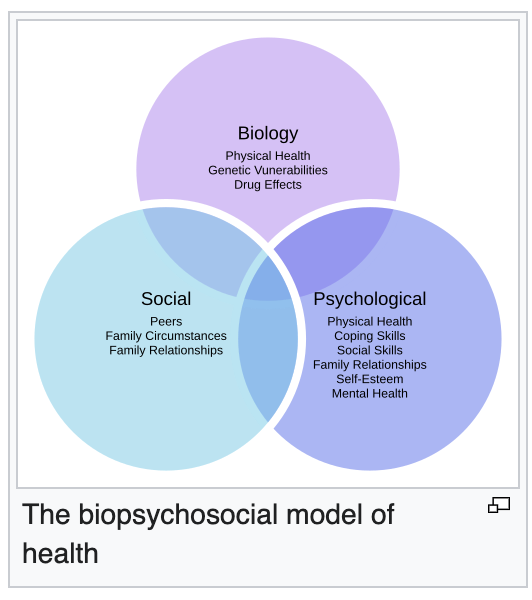 Illustration from Wikipedia entry "Biopsychosocial Model
Most simply put, sensing is a biological phenomenon and perception is biopsychosocial.
We have two kinds of neurons: sensory neurons convey information to the brain (afferent), and motor neurons convey information (commands?) from the brain (efferent). We have a wide array of sensory organelles (a tiny part inside a cell that does a specific job). Sensory receptors are grouped by where they get their signals; exteroceptors detect the outside world, interoceptors track internal organs, and proprioceptors measure body position.
Special senses are the human senses that have dedicated, complex sense organs located in the head. They include vision, hearing, equilibrium, smell, and taste. These contrast with general senses, like touch, which are spread all over the body. Pain reception (nociception) is often included, though recent research on pain disputes this, as the sense of pain is created in the brain (Rachel Zoffness PhD, Tell Me Where It Hurts). What we think of as the sense of touch involves at least six different kinds of receptors. If you want to get deeper into the anatomical and biochemical weeds of the subject I would recommend a text such as Biology of Sensory Systems by C.U.M. Smith.
For our purposes, the salient point is that approximately 99.9996% of human sensory input happens in background (unconscious) processing. The human nervous system takes in roughly 11 million bits of sensory information per second, but the conscious mind can only process about 40 to 50 bits per second. The body responds, but the conscious mind is usually completely unaware of what it is actually responding to.
This is particularly important in what I call sociception (a non-standard term). We are social animals, and our bodies are fine-tuned to sense the state of those around us and our relationships. We are wired to respond without knowing what we are responding to, subtle changes in expression, skin coloration, vocal tone, postures, positioning, etc. With mechanisms known and yet to be elucidated (mirror neurons come to mind, our bodies know, to some extent, the intentions of those around us.
 Flaneur (Out for a Stroll)
Contact
Richard Valasek 1308 Ala Kapuna St. Apt 103
Honolulu HI 9681
+1 (808) 256-1646
richard.valasek@gmail.com
to e-mail form
I am I and my circumstance;
and, if I do not save it, I do not save myself. —JOSÉ ORTEGA Y GASSET
 Changing the Conversation
I was born. I am always a vessel for something other than myself. The self is only a
vehicle for Foreign matter which comes from elsewhere and is destined to go on
elsewhere without me, whether it's words, smells, vision ––EMANUELE COCCIA Metamorphoses
 The Story Teller
Now, more than ever . . . our place in the universe and the place of the universe in us, is proving to be one of active relationship. That is more than a scientist's credo. The separateness of our lives is a sham. Physics, mathematics, music, painting, my love for you, my work, the star-dust of my body, the spirit that impels it, my politics, clocks diurnal, time perpetual, the roll, rough, tender, swamping, liberating, breathing, moving, thinking nature, human nature and the cosmos are patterned together.
—JEANETTE WINTERSON Gut Symmetries
What you do, what you become, is not my concern. –ROBERT MCCALL
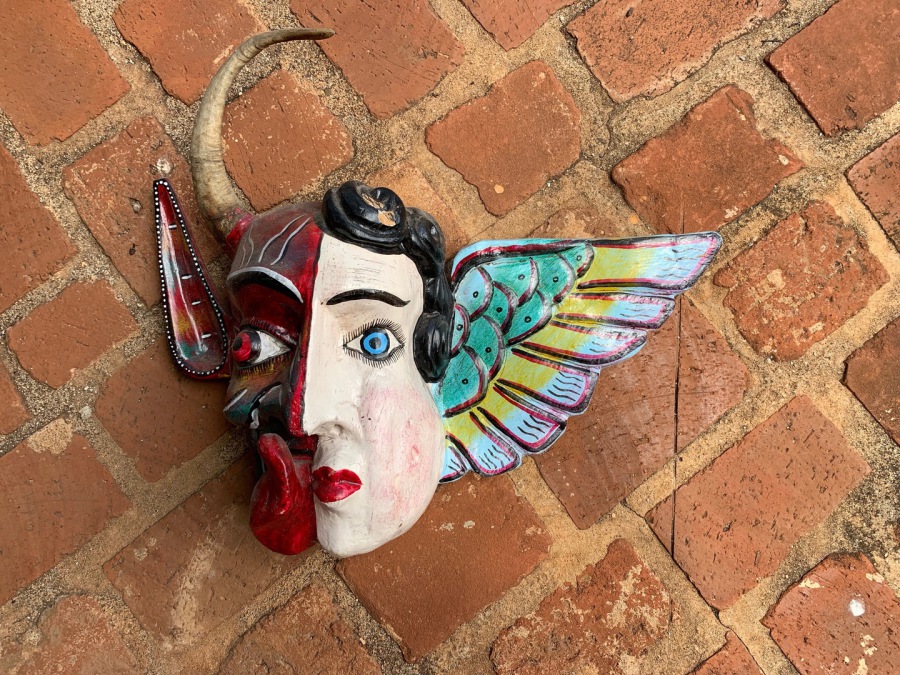 Agathokakological Mexican mask
Yes, there is beauty
There is love
There is joy.
All you who suffer from
the world's miseries
Defend them.
––EEVA KILPI
"Don't immanentize the eschaton."
––ERIC VOEGELIN
For the god of writing is also the god of death. He will punish the imprudent who, in their quest for unlimited knowledge, end up drinking the dissolved book.…To drink the tear and wonder about the strangeness of its taste compared to one's own...
Jean-Marie Benoist,
The Geometry of the Metaphysical Poets
There is no inside except as a folding of the outside. The mirror cracks; I am an other, and I always was.
Mark Fisher,
The Weird and the Uncanny
 Print
Print 